
Roll load cells GC2
Download PDF datasheet
Gicam roll load cells measure the tension of paper, plastic films, fabrics, rubber and metal strip on printing and converting machines. Cantilever, swivelling, bearing-mounted and pillow-block models.
Roll load cell
Easy to assemble, overload protection, internal amplifier capability 4-20mA / 0-10V, for bearings diameter 28, 32, 35, 40, 42 mm
Click on the image to enlarge

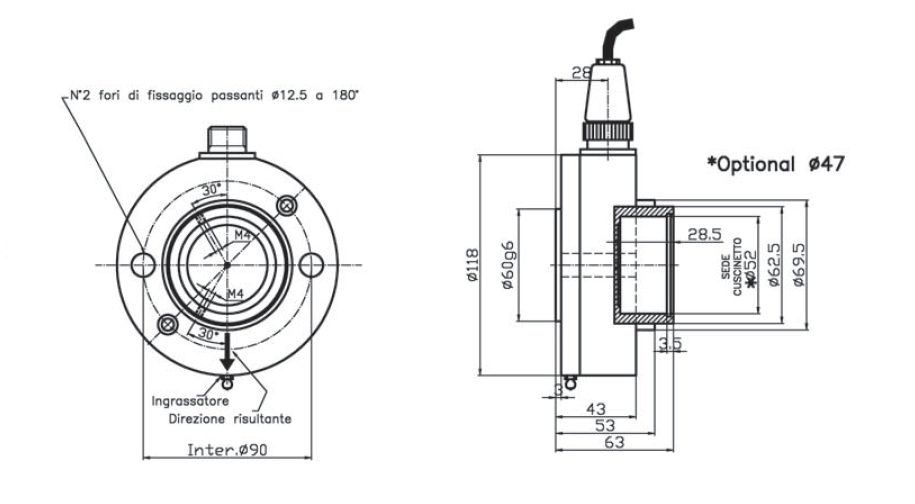


Technical specifications
| Material | Stainless steel |
|---|---|
| Nominal load | 25, 50, 100, 200, 400 kg |
| Limit load | 150 % F.S. |
| Breaking load | 300 % F.S. |
| Supply voltage | Maximum 18 V dc |
| Output | 2 mV/V |
| Output tollerance | 0,1 % F.S. |
| Zero tollerance | 1 % F.S. |
| Linearity | 0,1 % F.S. |
| Hysteresis | 0,05 % F.S. |
| Reapeatability | 0,1 % F.S. |
| Input resistance | 350-360 ohm |
| Output resistance | 350-353 ohm |
| Insulation resistance | >= 2000 Mohm |
| Creep (30 Minutes) | 0,05 % F.S. |
| Thermal compensation | -10 / +40°C (14 / +104°F) |
| Operating temperature | -20 / +70°C (-4 / +158°F) |
| Temperature deviation zero | 0,003 % F.S. / °C |
| Temperature deviation full scale | 0,002 % F.S. / °C |
| Protection class | IP 54 |
| Connection | Panel male connector CR2R-07APNS |
| Standard cable length | Optional: Loose female connector CR2P-07ASNS-10 , connection cable 4 x 0,25 mm2 (length to be defined) |
For complete and up-to-date technical specifications please refer to the datasheet you can download here
Download PDF datasheet Connections
| Type | CONNECTOR 7P SCC2A-16 |
|---|---|
| Length | 5 m (shield not connected to the cell body) |
| Pin 1 | + OUT |
| Pin 2 | - OUT |
| Pin 3 | NC |
| Pin 4 | NC |
| Pin 5 | NC |
| Pin 6 | + IN |
| Pin 7 | - IN |
Load cell mounting
General guidelines for installing and mounting load cells:
- Respect the direction in which forces are applied to the load cells
- Do not exceed the temperature limits shown on the rating plate
- Do not remove the labels from the cells
- Protect cables properly with sheaths or cable ducts
- Connect each cell to earth with a suitable cable, bridging the plates of the mounting accessories if necessary
- Do not weld on the mechanical structure once the cells are in place
- Avoid or minimise mechanical constraints between the fixed structure and the weighed structure, to prevent weighing errors and zero return problems
- When vibrations or dynamic loads are present, protect the cells with anti-vibration mounts
- Protect the cells from dust build-up with suitable covers